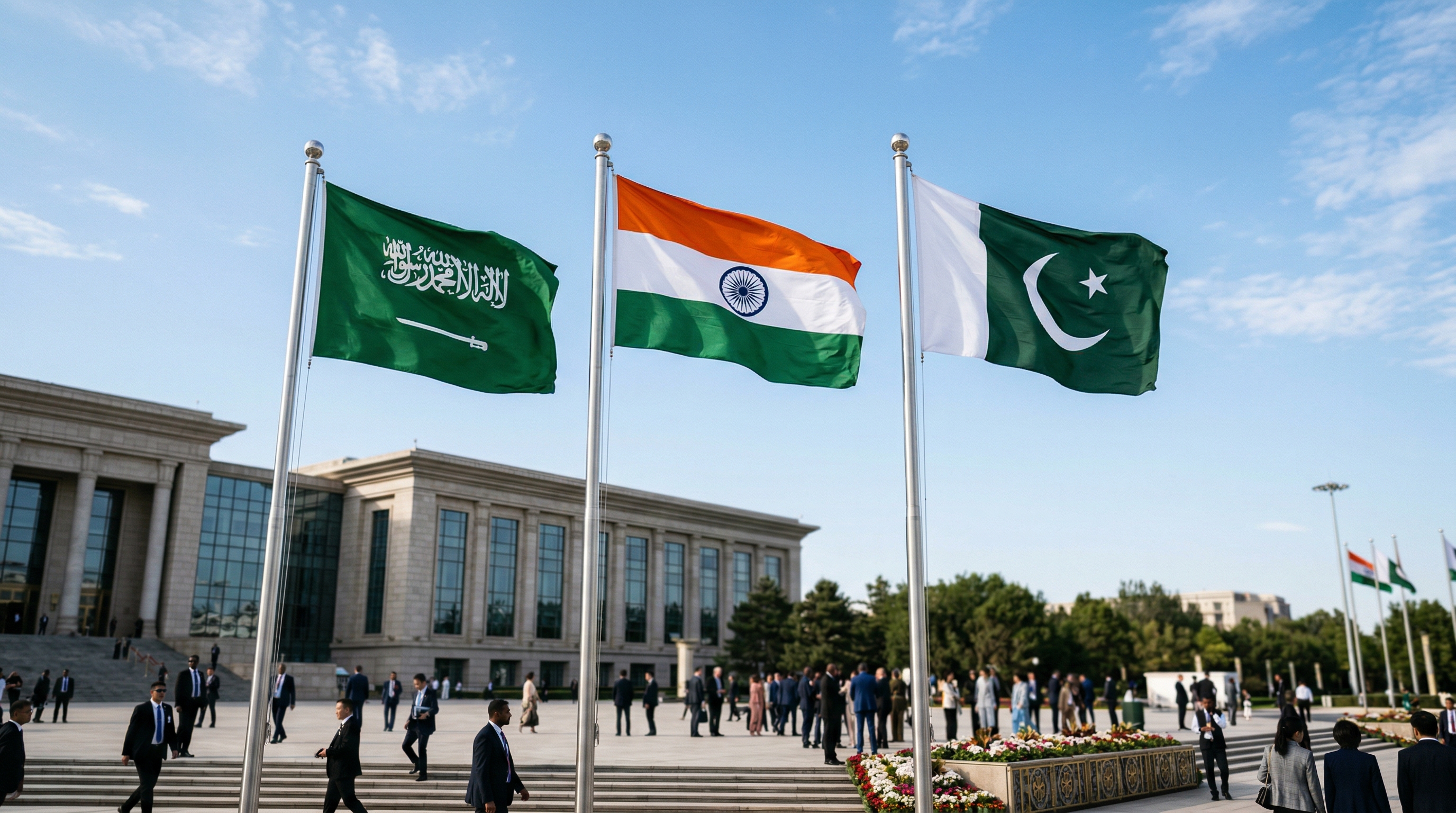
Saudi Arabia's Strategic Balancing Between India and Pakistan
Saudi Arabia maintains strong ties with both India and Pakistan despite their long rivalry. This balancing strategy helps Riyadh pursue its own interests through energy security, regional stability and Vision 2030 goals.
Saudi Arabia maintains strong ties with both India and Pakistan despite their long rivalry. This balancing strategy helps Riyadh pursue its own interests through energy security, regional stability and Vision 2030 goals. While oil remains central, India's economic importance and Pakistan's security role both shape Saudi policy.
Historical Foundations
The Pakistan-Saudi Arabia relationship started on a positive note in 1947, with the 1951 Treaty of Friendship based on their shared Sunni sect and Saudi protection of the two holiest sites in Islam, namely Mecca and Medina. Saudi Arabia provided financial support during the Cold War by funding Pakistan in the 1965 and 1971 wars against India, supporting claims in Kashmir and using millions of Pakistanis. Speculations are rife that Saudi Arabia funded Pakistan's nuclear program as a counterweight in the region, especially against Iran.
India's relationship with Saudi Arabia started in 1947 but faced setbacks in the early years. The relationship was mended in 1991 when India remained neutral in the Gulf War, followed by economic reforms that opened doors. In 2010, Saudi Arabia's King Abdullah rolled out a red carpet for Indian Prime Minister Manmohan Singh with a "strategic partnership" on oil, trade and combating terrorism. King Abdullah's visit to Delhi in 2006 was part of a renewed historical Arabian Sea trade route.
De-Hyphenation and the 2025 Defence Pact
The de-hyphenation strategy was further clarified post-9/11 as the Kingdom cracked down on terror funding from Pakistan soil and quietly aligned with India on the emerging concern over its neighbour. This became clear during Crown Prince Mohammed bin Salman's 2019 visits to Islamabad and New Delhi, when the Kingdom declined mediation in Kashmir."We don't link the two."
The September 2025 Saudi-Pakistan Defence Pact promised military support against "external aggression." India viewed this cautiously, seeing possible escalation in border tensions or as part of the Islamic NATO that could get the Saudis embroiled in the subcontinent against Pakistan or India. From the Saudis' perspective, this is hedging bets as Pakistan's battle-hardened army and nuclear capabilities could provide the Kingdom with insurance against the gaps left by the US as President Trump pulls back from the region. Oil supplies to India are also guaranteed as part of the Saudis' reassurances to New Delhi.
Oil: The Ultimate Lever and Limiter
The energy drives the relationship. Saudi Arabia supplies about 18 percent of India's crude oil demand, averaging over 600,000 barrels daily. Saudi Arabia is India's second-largest oil supplier after Iraq. Trade exceeds $35 billion annually, as well as the 2.6 million expatriates sending billions of dollars back to their motherland. The oil supplied to Pakistan may not be as great, but the 'lifelines' of $3 billion loans and $1.2 billion of deferred oil dues cannot be ruled out.
Oil gives Saudi Arabia leverage but also creates dependence. Cutting ties with India would hurt Vision 2030 projects such as NEOM, while Pakistan remains important for strategic balancing. Economic demand continues to outweigh political tensions.
“Saudi Arabia is playing both sides for maximum leverage.”
Why the Tilt Towards India?
Pragmatism explains the tilt towards India. India's 1.4 billion population, 7-8% GDP growth and expanding technology sector far outstrip the instability and bailout demands of Pakistan. Saudi Arabia has pledged $100 billion to the Indian energy, renewable and IT sectors. Defence cooperation with India has also been strengthened through two agreements signed in 2019 on intelligence sharing and joint exercises (SADA TANSEEQ).
Women driving, entertainment-oriented policies of MBS would be more suitable for the democratic government of India than the military government of Pakistan. Pakistan may have the soft power of manpower and Islamist credentials, but it also has the hard power of bases and nukes — and the emphasis of the Indian government on counter-terror operations and the market potential of the Indian market are in favor of the kingdom.
Potential Pitfalls
There are potential pitfalls. The alliance may draw Saudi Arabia into Kashmir via oil and diplomacy, leading to a breakdown in trust with India. India's 18 percent energy dependence makes it vulnerable. Labour issues with Nitaqat have already put a strain on the relationship. Saudi Arabia may react to Indian ire by shifting oil supplies to Russia and Iraq. China's CPEC in Pakistan and the Belt Road agreements may create tension with Saudi's strategy of keeping the US and India balanced.
Ripple Effects on Other Relationships
This agreement also has significant ripple effects:
- Gulf Dynamics: India is also putting pressure on the UAE, Qatar, and Oman, which are key players in the proposed IMEC trade corridor that competes with China's BRI.
- US and the West: Saudi Arabia is trying to reduce US dependence on the Middle East by using Pakistan to strengthen its position in the region.
- China-Pakistan Axis: This gives more strength to the CPEC and tests the Indian-led 'Quad' alliance with the US, Japan and Australia.
- Iran and OIC: Iranian perceptions of Sunni encirclement trigger proxy wars in Yemen and Syria. The OIC Kashmir campaign also antagonizes India.
Strategic Outlook
The balancing act by Saudi Arabia is being continued through economics and the agreement is taking its toll on the concept of de-hyphenation in the multipolar world order. The advice for India would be to look for diversified sources and strengthen the I2U2/IMEC, and the advice for Pakistan would be to look for economic reforms in order to avoid the marginalization scenario. Saudi Arabia is playing both sides for maximum leverage and as the world witnesses the rise of Trump 2.0 and China, it is the supplies of energy that would be the determining factor for the balancing act on the tightrope.
References
- Saudi Press Agency, Saudi-India Strategic Partnership Statement, 2025.
- Reuters, Saudi financial support and Pakistan oil arrangements, 2025-2026.
- India PMO / Trade data on Saudi energy imports.
- Economic Times Energy Report on Saudi-India petrochemical cooperation.
About the Author
Suman Keshanti is a contributor to Aguilar Commentary, providing independent analysis on international affairs and geopolitics.