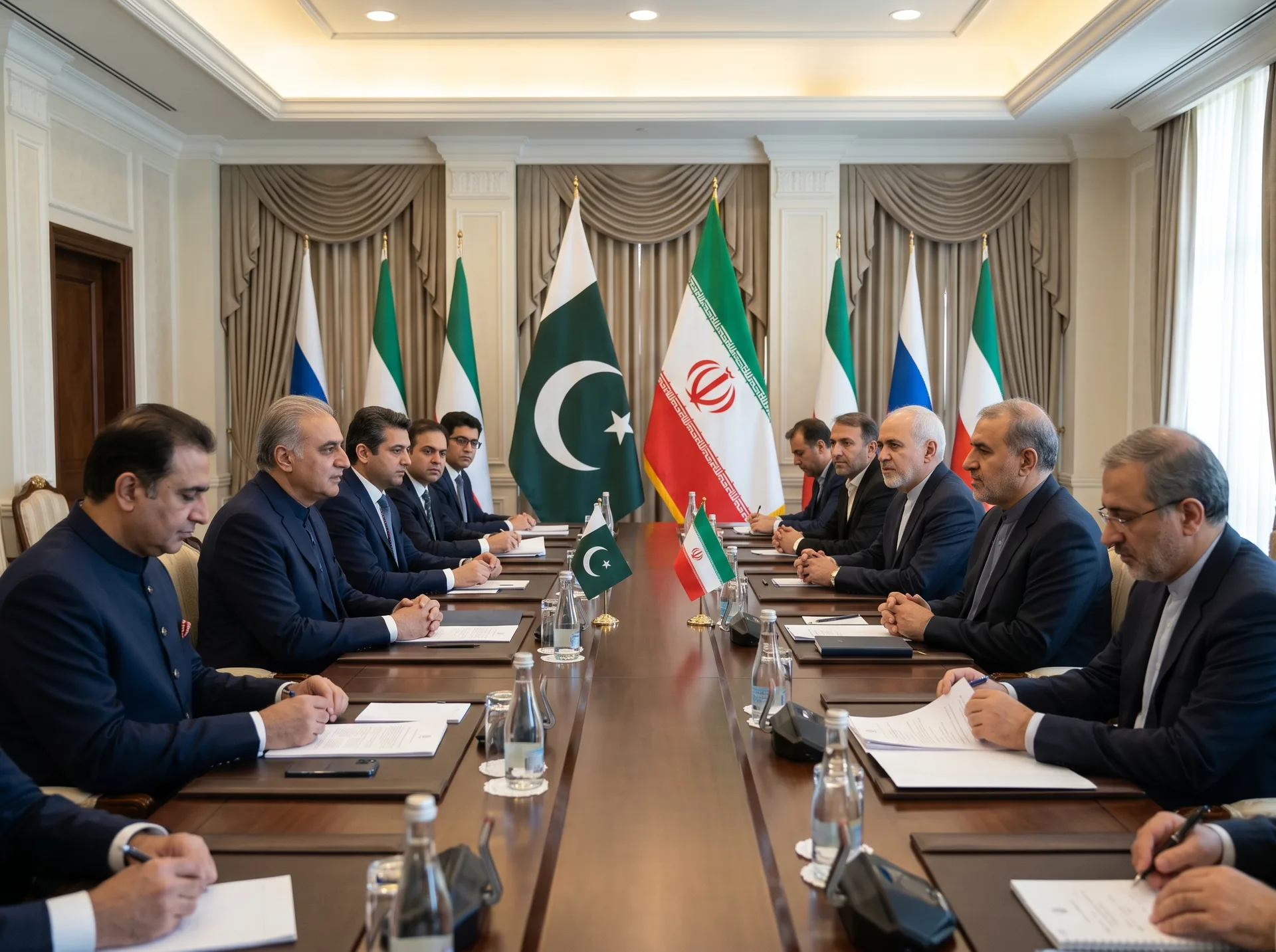
Pakistan at the Center of Iran and US Diplomacy
As fears of a wider Middle East war intensified in 2026, few countries possessed both the incentive and the ability to prevent further escalation. While military operations, sanctions, and retaliatory threats dominated international headlines, a quieter but equally consequential struggle was unfolding behind closed doors: the effort to preserve diplomacy between Iran and the United States. At the center of that effort stood Pakistan, a country whose geography, diplomatic relationships, and strategic interests placed it in a uniquely influential position. In a region increasingly defined by polarization, Islamabad found itself performing one of the most delicate balancing acts in contemporary diplomacy.
For Pakistan, involvement in the Iran-US negotiations was not simply an opportunity to enhance its international standing. It was a matter of national security, economic stability, and regional necessity. A prolonged conflict between Washington and Tehran threatened to destabilize Pakistan's western border, disrupt energy supplies, damage regional trade routes, and create new security challenges across South Asia and the Middle East. Consequently, Pakistan's mediation efforts reflected not only diplomatic ambition but also a clear understanding that de-escalation served its most fundamental national interests.
What made Pakistan particularly valuable as a mediator was its ability to maintain meaningful relationships with all major stakeholders involved in the crisis. Few countries simultaneously maintain active channels of communication with Iran, the Gulf states, China, and the United States. While many regional actors are perceived as belonging firmly to one geopolitical camp, Pakistan has increasingly pursued a strategy of multi-alignment. Rather than choosing sides in an increasingly fragmented international system, Islamabad has sought constructive engagement with competing powers, enabling it to communicate with rival capitals even during periods of heightened tension.
Pakistan's relationship with Iran provided an important foundation for its diplomatic role. The two countries share a nearly 900-kilometer border, deep cultural and religious ties, and decades of engagement. Iran was among the first states to recognize Pakistan after independence, while Pakistan's large Shia population further strengthens bilateral connections. Simultaneously, Pakistan maintains extensive relationships with Saudi Arabia, the United Arab Emirates, Qatar, and other Gulf states through strong economic, security, and people-to-people ties, enabling Islamabad to engage constructively with competing regional actors.
Pakistan's relationships with major powers complement this unique regional positioning. China remains its closest strategic partner through the China-Pakistan Economic Corridor, while ties with the United States have gained momentum through cooperation in security, trade, and investment. Together, these relationships provide Pakistan with the diplomatic flexibility to engage credibly with rival capitals. Geography further reinforces Islamabad's commitment to de-escalation, as any conflict involving Iran could threaten border security, disrupt energy supplies, and undermine Pakistan's economic and regional stability.
Pakistan did not force itself into the process; it became indispensable because both sides considered it a useful and acceptable bridge during a period of profound mistrust.
A critical question surrounding Pakistan's role concerns whether it was asked to mediate or volunteered to act as an intermediary. Available diplomatic reporting suggests that the process emerged through mutual acceptance rather than a formal request from either side. Pakistan actively utilized its diplomatic channels, communication networks, and relationships with both governments, while Washington and Tehran appeared willing to engage through Islamabad because few alternative mediators enjoyed a comparable degree of access and credibility.
Questions have also been raised regarding what guarantees Pakistan sought before facilitating negotiations. No public evidence suggests that Islamabad received formal written commitments from either Iran or the United States. However, diplomatic practice strongly suggests that Pakistan would have sought assurances regarding good-faith participation, respect for the mediation process, continued engagement through established channels, and the security of all diplomatic exchanges. Hosting negotiations between deeply distrustful adversaries carries significant political and reputational risks.
Pakistan's diplomacy during the crisis highlighted a rare civil-military coordination model. Field Marshal Asim Munir maintained direct communication with US counterparts, complementing diplomatic efforts led by Prime Minister Shehbaz Sharif and Foreign Minister Ishaq Dar. Donald Trump praised Munir, calling him his favorite Field Marshal and suggesting his strong understanding of Iran. This unusual access reflected growing confidence in Pakistan's military leadership in Washington. Meanwhile, civilian and military alignment ensured consistent messaging, presenting a unified, credible national stance.
Pakistan's emergence as a mediator also carried historical significance. This was not the first time Islamabad had played a bridging role during a major geopolitical confrontation. In 1971, Pakistan helped facilitate secret contacts between the United States and China, paving the way for Henry Kissinger's historic visit to Beijing and eventually President Richard Nixon's landmark trip. Many observers viewed the Iran-US negotiations as a modern reflection of Pakistan's longstanding ability to connect rivals who lacked direct trust.
Nevertheless, Pakistan's involvement was not without criticism. Analysts questioned whether a state managing tensions with Afghanistan and India could credibly act as a peace broker, while others warned that failure could damage relations with one or both sides. Concerns also arose over Pakistan's defense cooperation with Saudi Arabia, with some suggesting Tehran might question Islamabad's neutrality. The risks were significant; if negotiations collapsed, Islamabad could face accusations of diplomatic naivety or ineffectiveness.
No publicly disclosed agreement indicates that Pakistan received direct economic compensation for its efforts. However, it undeniably gained diplomatic capital, international visibility, and enhanced strategic relevance. Senior American officials publicly acknowledged Islamabad's contribution to regional stability, while discussions regarding trade, investment, security cooperation, and broader bilateral engagement gained momentum.
Ultimately, Pakistan's confidence in its role stems not from guarantees of success but from confidence in the value of dialogue itself. Given the decades of mistrust separating Iran and the United States, no mediator could realistically guarantee a comprehensive settlement. Yet reducing misunderstandings, preventing escalation, and keeping diplomatic channels open remain meaningful achievements. Pakistan's role in the negotiations reflected the broader evolution of its foreign policy and demonstrated the strategic value of balanced diplomacy. In an international system shaped by rivalry and mistrust, influence does not always belong to the strongest powers. Sometimes it belongs to the states capable of keeping adversaries talking when everyone else has stopped listening.
Pakistan · Iran · United States · Diplomacy · Mediation · South Asia
About the Author
Areeb Imran is a contributor to Aguilar Commentary, providing independent analysis on South Asian affairs, diplomacy, and international security.