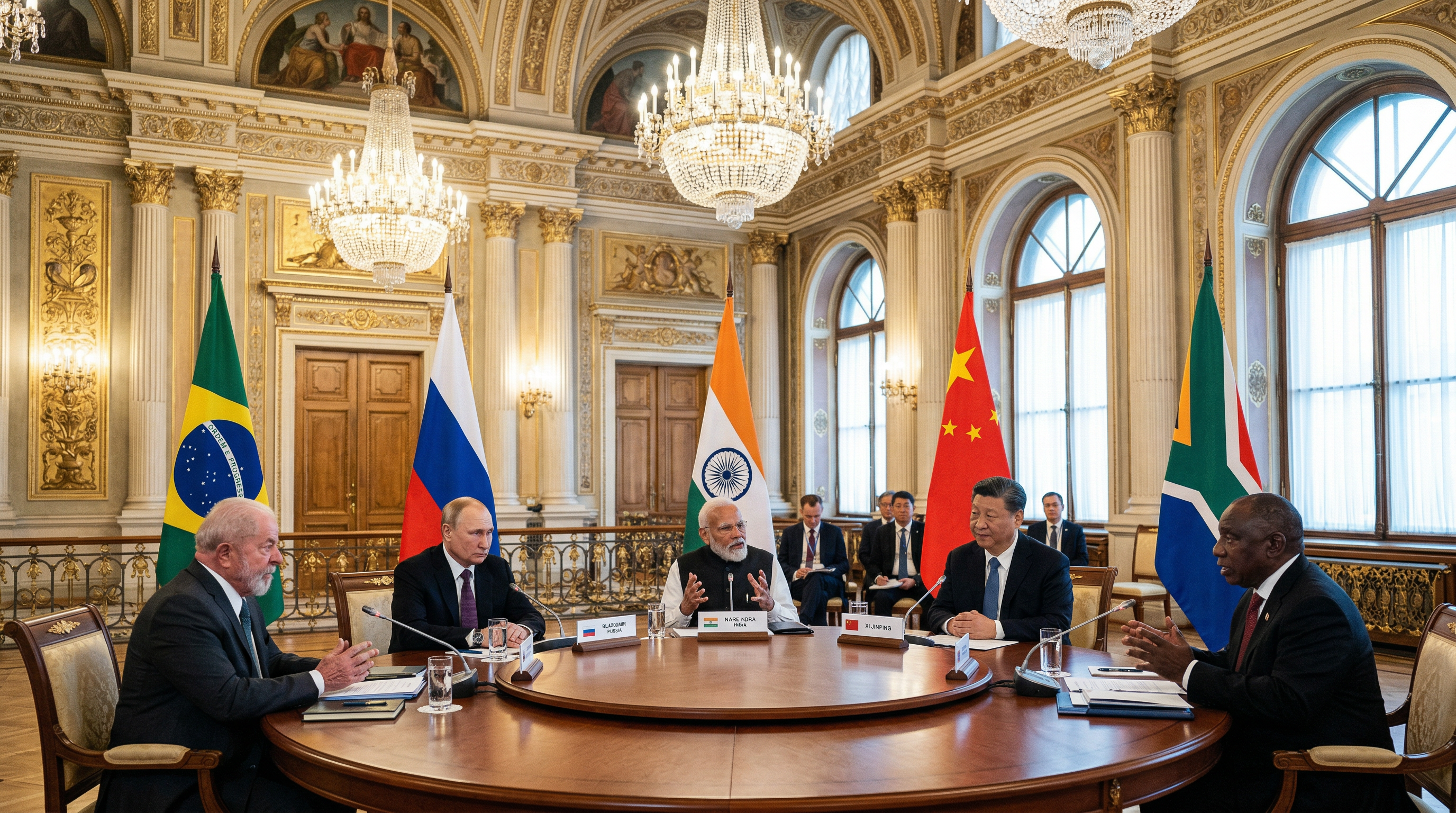
BRICS and the Strait of Hormuz: Can the Bloc Step Up?
The Iran-Strait of Hormuz standoff is a stress test for BRICS as a geopolitical force. With Iran, Saudi Arabia, and the UAE now inside the bloc, can BRICS broker a maritime security framework — or will internal divisions expose its limits?
Introduction
The current military standoff between the two nations is quickly turning out to be an international stress test of energy security, commerce, and crisis negotiation. With the conflict threatening the vital Straits of Hormuz — which carries about a fifth of all international oil and liquefied natural gas transportation — it becomes imperative who could negotiate and resolve the matter at hand. Here, the significance of the BRICS organization comes into play as a political and not simply economic organization. The recent addition of Iran, Saudi Arabia, and the UAE means that the organization will have both warring nations within its ambit.
BRICS and Diplomatic Capacity
In the past, BRICS has acted more like an informal consultation platform than a coalition, which would be more appropriate. The joint declarations of BRICS concerning the period between 2023 and 2025 stress that mediation, preventive diplomacy, and conflict resolution are carried out peacefully, following the UN Charter, yet no enforcement mechanisms and crisis management organizations exist in this regard. It is against this backdrop that the foreign policy priorities of Brazil, Russia, India, China, and South Africa differ significantly. Russia, being a friend of Iran since the time of the Soviet Union, has always wanted to form a strategic partnership with Iran, while at the same time rejecting any kind of US military intervention. On the other hand, Brazil and South Africa favored non-aligned diplomacy, based on the UN Charter.
The expansion of BRICS in 2024 will intensify the importance of the block as well as the level of contradiction within the organization. The inclusion of such influential players as Iran, Saudi Arabia, and the UAE — who share security interests yet also have contradictory goals — will provide BRICS with greater influence in the Middle East region but will also make its activities more complex. Iran insists that the group condemns foreign military intervention and utilizes its power to restrain Western countries in this regard. On the other hand, the newly included Gulf countries will be concerned about any initiative by the BRICS bloc which fails to address issues related to Iranian missiles and drones that could pose a potential threat to Gulf states.
A BRICS-Based Framework for the Strait of Hormuz
Since the common objective of BRICS countries is to ensure navigational freedom in the Strait of Hormuz, a possible diplomatic solution would be the establishment of a neutral maritime security regime in the strait, sponsored by BRICS. Such a regime would allow BRICS to establish a multilateral system whereby the sovereignty of the coastal nations would be separated from the security of merchant ships navigating through the strait. This includes establishing a neutral "safe passage corridor," under the auspices of a rotating BRICS naval and coast guard command center; legally binding assurances from both Iran and the Gulf nations that merchant ships will not be attacked unless they fall into a specific category recognized by the council; and establishing an independent monitoring organization, possibly including BRICS observers and other technical partners like the International Maritime Organization.
Such an approach should be premised on the idea that the Strait of Hormuz is not only a bilateral bottleneck but a major energy thoroughfare. The situation with over a dozen ships carrying the Indian flag stuck west of the strait due to the latest tensions clearly shows how pressing this matter is. The fact that China has consistently preferred de-escalation and has shown its willingness to use diplomacy rather than force suggests that it may agree to support a politically-oriented security mechanism facilitated by the BRICS countries, as long as it does not involve any clash between the People's Republic of China and the United States or Israel.
“The Strait of Hormuz is not only a bilateral bottleneck — it is a major energy thoroughfare for the entire world.”
Internal and External Obstacles
Feasibility of such an approach is hampered by internal divisions and external influences. BRICS will be hindered by internal challenges owing to the lack of an established diplomatic process, thus making decision-making through consensus difficult. The more members are added to the organization, the more challenging it will be to agree — while Russia and Iran would prefer a tough stand against the West, Saudi Arabia and the United Arab Emirates will certainly demand acknowledgment of their security considerations vis-a-vis Iran.
From an external perspective, BRICS has to deal with the presence of United States'hegemonic influence in the region and security considerations of Israel. The US has been treating the Persian Gulf region as one of its most important strategic areas and continues to be the main sponsor of maritime security operations in the context of the Gulf. US sanctions on Iran, coupled with the Western sanctions regime against Iran, provide another complicating factor — BRICS countries will have to consider their interests in the context of these sanctions while navigating US-led diplomacy in the area. Israel's security concerns relating to Iranian missile and drone capabilities, as well as Iranian proxies in the region, made it reluctant to accept any negotiation process that did not include explicit conditions placed on Iran's conduct.
BRICS as a Test of Future Power
The crisis associated with Iran, particularly the Strait of Hormuz, serves as a litmus test for the potential of the BRICS grouping. Failure by BRICS to coordinate a minimal amount of diplomacy in dealing with the situation will mean that it will only be able to play the role of an economic bloc without taking any significant steps towards becoming a geopolitical force. Even though India and China both advocate stability, their actions have been taken independently through their own nations' foreign policy rather than as part of a BRICS initiative.
References
- Reuters (2026)
- BRICS Joint Declarations (2023-2025)
- International Maritime Organization reports
- United Nations Charter
- Recent Gulf maritime security coverage
About the Author
Suman Keshanti is a contributor to Aguilar Commentary, providing independent analysis on international affairs and geopolitics.