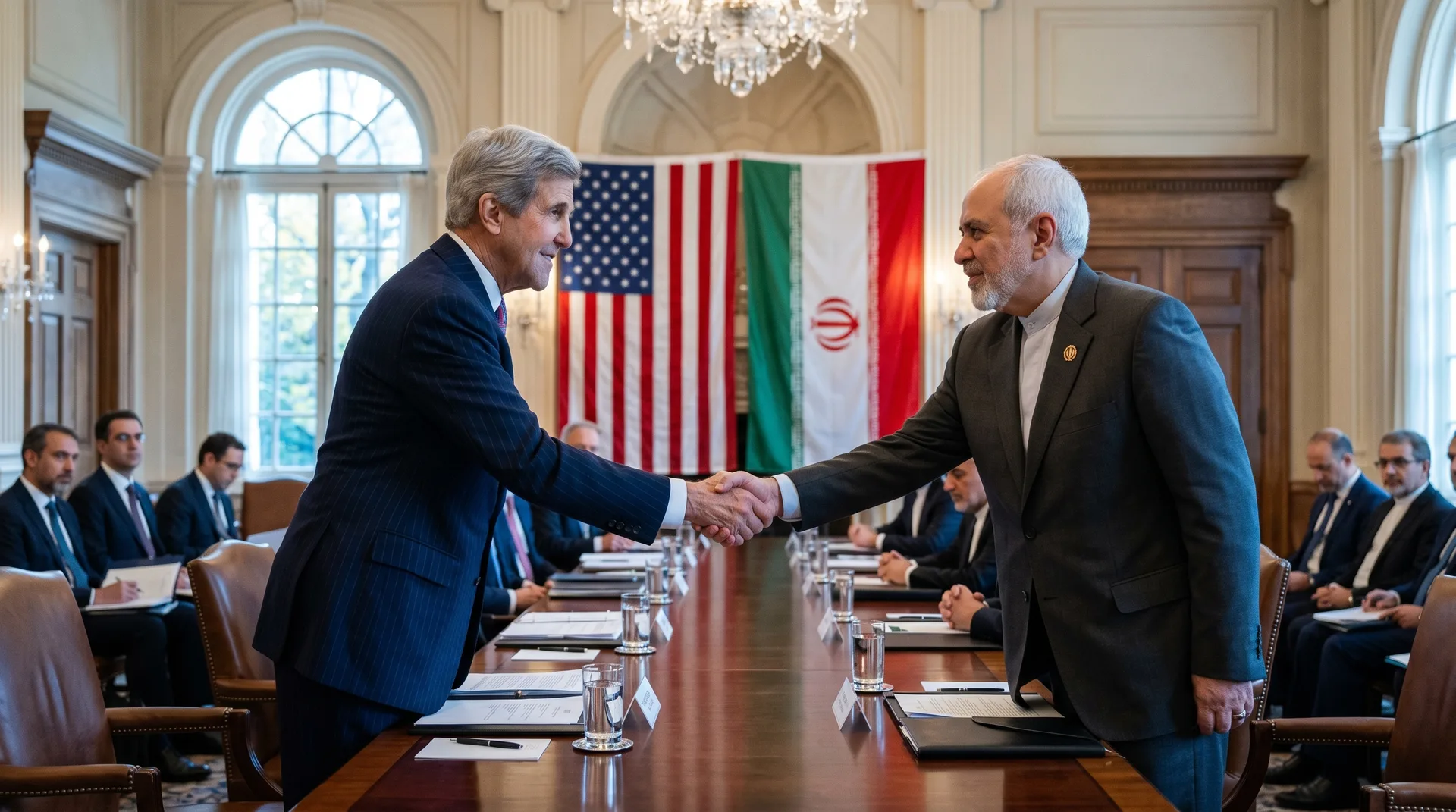
Art of the Deal or Capitulation
As the Trump administration struggles to present the MOU as a crowning achievement, one could be forgiven if they found parts of the US-Iran MOU to be reminiscent of the Joint Comprehensive Plan of Action (JCPOA) negotiated by the Obama administration in 2015. The agreement took several years to accomplish through a team that consisted of John Kerry, Secretary of State, William Burns, Undersecretary of State, Wendy Sherman, Undersecretary of State for political affairs, Jacob Lew, Treasury Secretary and Ernest Moniz Secretary of Energy. This is juxtaposed with the team which was headed by real estate mogul Steve Witkoff and Jared Kushner.
When President Trump unilaterally pulled out of the JCPOA in 2018, it was with an expectation that he could negotiate a better deal. What is forgotten is that after the United States pulled out of the JCPOA, Iran was unconstrained to create 60 percent enriched uranium. Unfortunately, despite sanctions the administration failed to get Iran back to the negotiating table during his first term. In 2026, in what seems like a perverse version of the 1959 movie "The Mouse That Roared" Iran has seemingly come away with a tremendous achievement.
Many politicians, especially from the right, were highly critical of the Obama administration for repatriating 1 billion dollars of Iranian funds back to Iran. The present figure to be returned is at least 25 billion dollars with a potential of 300 billion dollars to be given for reconstruction. It will be interesting to hear how the administration will spin this as a better deal. One can imagine defenders of the plan bringing up the Marshall Plan. The difference is that the Marshall Plan went into affect after Hitler and the Nazi regime was gone. Senator Lindsey Graham said "the idea of a 300 billion reconstruction fund given who is in charge of Iran seems to be tone deaf. It would be akin to a Marshall Plan for Germany with the Nazis still in charge." The main component of the MOU is that the Strait of Hormuz will reopen. It is difficult to depict the reopening of the strait as a victory since it is simply a return to the status quo.
Nonetheless, one thing which is guaranteed is that institutions such as the Hoover Institute will twist themselves out of shape to find a way to make sure the JCPOA is not seen as superior to the MOU.
The political aspect of this deal is revealing. The administration has rolled out Vice President JD Vance to sell the agreement and to Switzerland to sign the agreement. Many commentators have come to the conclusion that Vance is being set up as the fall guy if this deal falls through.
Many observers believe that the administration started this war because of Prime Minister Benjamin Netanyahu who convinced him that the war would be an easy victory. Unfortunately, the administration has spent billions of dollars, lost the lives of 13 American soldiers (ironically the same number of soldiers killed when the United States left Afghanistan), created financial stress for millions, depleted military munitions, for an agreement that while not yet complete - for a war many military experts have deemed to be a strategic disaster. To be fair the MOU calls for additional negotiation. It is quite possible that by the end of this whole ordeal the United States may indeed have a deal that benefits the nation and the Gulf region.
There is no doubt that the Iranian regime is an evil regime. It has perpetrated tremendous harm towards its people. It is good that the bombing has ended for now but it is believed that Iran has come out in a stronger position as a result of the war.
Iran · US Foreign Policy · JCPOA · MOU · Nuclear Deal · Middle East
About the Author
Tony Aguilar is the founder of Casa Margo Communications Group and a veteran political analyst and commentator specializing in international affairs, democracy, and U.S. foreign policy.